
MECHANICS DESK · RTP GUIDE
Why Slot RTP Cannot Predict What Happens in Your Session
RTP is useful for comparing designed return over enormous volumes of play. It is almost useless as a prediction of what your balance will show tonight.
THE MECHANISM IN BRIEF
- RTP divides aggregate prizes by aggregate stakes
- One session is too small to expect the published percentage
- Volatility describes the spread around the long run average
Slot RTP is a long-run design figure, not a forecast for your next session. A game showing 96% RTP is not promising to return 96 cents from your next dollar, or $96 from the next $100 you stake.
The useful comparison sits at game level: over a sufficiently large volume of qualifying play, the designed ratio of prizes to stakes is 96 to 100. The UK Gambling Commission’s consumer guidance is explicit that RTP is an average achieved over a significant number of plays rather than every time a machine is played.
What Does Slot RTP Measure
Slot RTP measures total prizes divided by total stakes across the game’s measured play. If aggregate stakes were $1,000,000 and aggregate prizes were $960,000, the measured return would be 96%.
That ratio says nothing about the order of the prizes. One player could encounter a large award early. Another could see a long stretch of small returns. The combined result may move towards the designed percentage as the sample becomes enormous, while either individual session can remain far away from it.
What Does A Ninety Six Percent RTP Cost In Theory
A 96% RTP implies a 4% theoretical house edge because 100% minus 96% equals 4%. The edge applies to turnover, which is the sum of every stake placed, including money that has already been returned and staked again.
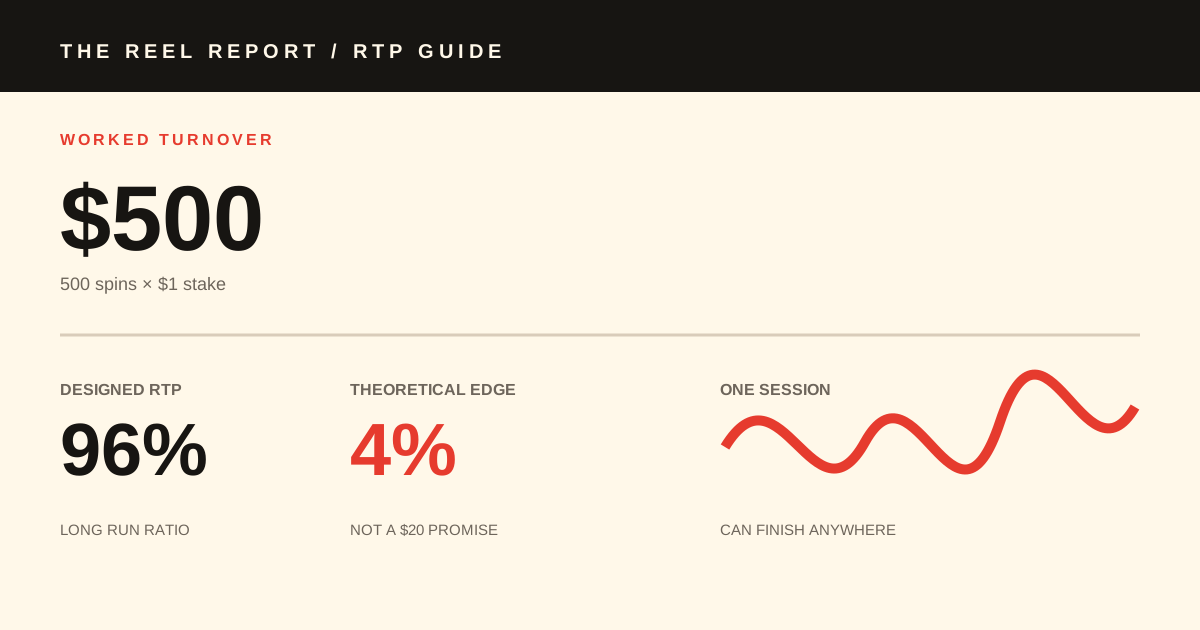
Consider 500 spins at $1 each:
| Calculation | Amount |
|---|---|
| Total turnover | $500 |
| Designed RTP | 96% |
| Theoretical long-run return | $480 |
| Theoretical long-run cost | $20 |
The $20 is not a predicted loss for that session. It is the mathematical expectation attached to $500 of turnover if the game were observed across a sample large enough for its designed return to become stable. The actual session might finish ahead, lose the full budget or land anywhere between.
The regulator’s RTP monitoring example shows why volume matters. Even after hundreds of thousands of games, an observed result can sit above or below the designed percentage within a statistically expected range.
Why Does Volatility Change The Session
Volatility changes how the game distributes returns around its average. A higher-volatility slot tends to concentrate more of its theoretical return in less frequent, larger awards. A lower-volatility design tends to distribute more of it through smaller, more frequent awards.
Two games can therefore publish the same RTP and feel completely different across the same number of spins. RTP describes the destination of an enormous statistical sample. Volatility shapes the route, including how rough a short section of that route can be.
Neither number predicts the next outcome. They describe game design, not a timetable for wins.
Can A Losing Slot Become Due To Pay
A random slot is not due to correct your personal results after a losing run. Each result follows the game’s random process and published rules; the machine does not need to repay one player so their session matches the theoretical percentage.
This is the same reasoning that applies inside a feature. A nearly full grid or an expiring counter may intensify the presentation, but it does not create a debt. Our guide to hold-and-win respin counters maps that distinction at feature level.
How Should You Compare Two Slot RTP Figures
Use RTP as one filter, not a session promise. Check that the percentages cover the same version of each game, then compare total stake, volatility, feature eligibility and whether optional bets alter the return.
A practical check has four parts:
- Open the information or help screen before staking.
- Confirm the RTP for the version being offered.
- Check whether the selected bet level or optional feature changes the rules.
- Set the money and time limit without using RTP to justify a larger budget.
The Slot Machine Casino news archive keeps these mechanics separate so each number answers one question. Understanding the number improves the comparison. It does not create a way to beat a random game.
The Number That Matters During Play
During a session, the relevant number is the fixed amount you chose to spend on entertainment. RTP cannot turn that amount into an investment forecast. If the limit is reached, the session is over regardless of whether the game appears cold, close to a feature or due for a correction.
Gambling should never be used to solve financial pressure. If play is becoming difficult to stop, use the limit, break and self-exclusion tools available through the operator and provincial support system.
PAYTABLE QUESTIONS
Questions this guide answers
Does 96 percent RTP mean I get 96 cents back from every dollar?
No. It is a theoretical average across a very large volume of play, not a result promised on each spin or in each session.
Is a higher RTP always the better slot?
It is a useful comparison when the games and rules are otherwise comparable, but volatility, stake, feature rules and your fixed entertainment budget also change the experience.
Can a slot be due to correct its RTP after a losing run?
A random slot does not owe an individual player a correction. Previous wins and losses do not make the next random outcome due.
Sources and further reading
- Return to player how much gaming machines payout — UK Gambling Commission
- How to calculate return to player RTP — UK Gambling Commission
- What is safer gambling — Responsible Gambling Council